Music
for Flute and Harp
Buy this album now CD: £12.00 + p&p |
| David Watkins profile page with index of recordings and compositions |
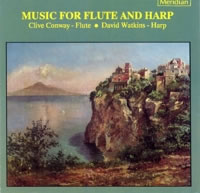 The
flute with harp is a delicious combination, mellifluous and pleasing
and much music has been written for these two instruments including
Mozart's famous Concerto. In "Music for Flute and Harp" Clive
Conway and I perform music by Mozart, Krumpholtz (Haydn's harpist
at Esterhazy) and other classical composers. Jill Hughes joins
us in the beautiful Interlude from the "Childhood of Christ" by
Berlioz.
The
flute with harp is a delicious combination, mellifluous and pleasing
and much music has been written for these two instruments including
Mozart's famous Concerto. In "Music for Flute and Harp" Clive
Conway and I perform music by Mozart, Krumpholtz (Haydn's harpist
at Esterhazy) and other classical composers. Jill Hughes joins
us in the beautiful Interlude from the "Childhood of Christ" by
Berlioz.
| 1 | Anonymous | Variations on Greensleeves | 2’ 05” |
| Vivaldi | Sonata in C | ||
| 2 | Allegro non molto | 2’ 48” | |
| 3 | Larghetto | 3’ 24” | |
| 4 | Allegro | 1’ 52” | |
| Boismorter | Sonata in G minor | ||
| 5 | Gayement | 3’ 28” | |
| 6 | Gracieusement | 3’ 22” | |
| 7 | Gayement | 2’ 20” | |
| 8 | Gluck | Orphée - Dance of the Blessed Spirits | 5’ 45” |
| Mozart | Sonata in C | ||
| 9 | Allegro | 4’ 00” | |
| 10 | Allegro | 2’ 55” | |
| 11 | Menuetto | 3’ 00” | |
| Krumpholtz | Sonata in F | ||
| 12 | Allegro | 5’ 35” | |
| 13 | Romanza | 4' 03” | |
| 14 | Tempo di minuetto en Rondo | 3’ 24" | |
| 15 | Rossini | Andante con variazioni | 4’ 16” |
| 16 | Chopin | Variations on a theme of Rossini | 5’ 30” |
| 17 | Berlioz | Trio from L’Enfance du
Christ (with Jill Hughes - flute) |
7' 20” |
TOTAL TIME |
1' 04' 46" |
||
ANONYMOUS: 17th Century Variations
on Greensleeves
This is one of the
most popular tunes from the British Isles, mentioned
twice by Shakespeare, and set by many composers
since the sixteenth century, most notably Vaughan
Williams in Sir John in Love.’
ANTONIO
VIVALDI: 1675-1741 Sonata in C
Allegro non
motto - Larghetto - Allegro
Vivaldi was the most prolific composer of his time, writing for
all combinations of instruments. He wrote nearly 400 concertos,
operas, oratorios and chamber pieces. David Watkins baa arranged
this sonata for flute and harp from a trio for violin, lute and
figured bass.
BODIN
DE BOISMORTIER 1689-1755 Sonata in G minor (No.2)
Gayement -
Gracleusement - Gayement
Boismortier spent much of his life in Paris. This sonata is taken
from a set of six written in 1742. The musical invention it exhibits
is astonishing, and some of the ideas are thirty years in advance
of the time. The flute and harp parts are of equal importance
and are written out in full by the composer - innovative indeed,
as other accompaniments of this period would have been written
out as figured basses, to be embroidered at will by the performer.
CHRISTOPH
GLUCK: 1714-1787 Dance of the Blessed Spirits
This is one of the most memorable interludes in Gluck’s
opera Orfeo; written in Vienna in 1762. The arrangement for flute
and harp captures perfectly the mood of this Elysian scene.
WOLFGANG
AMADEUS MOZART: 1756-1791 Sonata in C, K.V.14
Allegro - Allegro
- Minuetto primo - Minuetto secondo - (En Carillon)
Even this composition from the eight-year-old Mozart hints at
the greater works to come. Originally a sonata for keyboard with
accompaniment of a violin or flute, it has been reworked to interchange
some of the voices. In the eighteenth century keyboard parts
were often played on the harp, and in a work like this the harp
conveys the original sound rather better than a modem piano.
JEAN-BAPTISTE
KRUMPHOLTZ: 1745-1790 Sonata in F
Allegro - Romanza
- Tempo di Minuetto en Rondo
Krumpholtz was born in Prague, studied in Paris and was then
engaged by Haydn for the orchestra of Prince Esterhazy in Hungary.
He returned to Paris, where he taught Mlle de Guines (the dedicatée
of the Mozart Concerto for flute and harp) and made a great name
as a harpist and composer. Many said that his wife was a better
performer on the harp, and when she ran off with her lover, he
threw himself into the Seine. David Watkins has made this performing
edition from the original engraving in the Clive Morley Library.
GIOACCHINO
ROSSINI: 1792-1868 Andante con variazioni
Rossini used a melody from his opera Tancredi (the cavatina ‘Tu
che accendi questo core’) for this delightful work. After
a dramatic introduction, the beautiful theme is stated in a simple
form for both instruments. Four variations follow, exploring
the technique on both instruments to the full.
FRÉDIÉRIC
CHOPIN: 1810-1849 Variations on a theme of Rossini
The simple accompaniment in this composition belies the genius
of Chopin. The subtlety and imagination, however, lie in the
flute part, which, after a straightforward statement of the theme,
is developed with breathtaking virtuosity. Four variations succeed
the theme.
HECTOR
BERLIOZ: 1803-1869 Trio from L’Enfance du Christ
This exquisite trio for two flutes and harp is the centrepiece
of Berlioz’s oratorio the 'Childhood of Christ.’ It
is a complete composition by itself, with a brief opening Allegro,
an Andante Espressivo which returns after a section marked Allegro
vivo. Clive Conway is joined by Jill Hughes in this recording.
Credits
All of the works in this recording have been edited by David Watkins.
Digitally recorded in St. Edward
the Confessors Church, Mottingham, London, using an AKG C24
microphone
Recorded by Richard Hughes, Produced by John Shuttleworth
Musical supervision by Rachel Smith, Assistant engineer: Paul
Jacques
Cover picture courtesy of Attwell Galleries
Project co-ordinated by Clive Conway
MERIDIAN RECORDS, P0 BOX 317, ELTHAM, LONDON, SE9 4SF.
©MERIDIAN RECORDS 1993
| Instruments: | Flute and Harp |
| Genre: | Classical |
| Format: | CD |
| Our Ref: | A0216 |
| MCPS: | CDE 84241 |
| Label: | Meridian |
| Year: | 1993 |
| Origin: | UK |