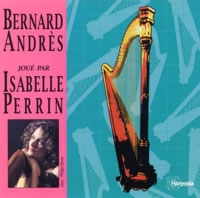
Bernard Andrès performed by Isabelle Perrin
|
| Artist Profile and index of recordings and sheet music |
| Préludes | ||
| 1 | No 1 | 2.14 |
| 2 | No 3 | 1.30 |
| 3 | No 8 | 2.09 |
| 4 | Anamorphoses | 6.53 |
| Danses d'automne | ||
| 5 | No 1 | 1.27 |
| 6 | No 2 | 1.46 |
| 7 | No 3 | 2.07 |
| 8 | No 4 | 1.47 |
| 9 | No 5 | 1.59 |
| 10 | No 6 | 2.20 |
| Epices | ||
| 11 | Muscade | 1.52 |
| 12 | Vanille | 2.26 |
| 13 | Pistache | 3.09 |
| 14 | Paprika | 1.56 |
| 15 | Safran | 2.36 |
| 16 | Cannelle | 2.03 |
| 17 | Kola | 1.45 |
| 18 | Gingembre | 2.10 |
| 19 | Acalèphes | 2.13 |
| 20 | Elégie | 7.26 |
| Preludes | ||
| 21 | No 12 | 3.02 |
| 22 | No 13 | 2.27 |
| 23 | Duke | 3.23 |
| 24 | Tanka | 6.40 |
Total
Time |
67.54 |
|
Sleeve Notes
Bernard Andrès was born in Belfort in 1921. He received a teaching degree in music at the age of 21, studying both at the Besançon and Strasbourg conservatories. Subsequently, Andrès pursued brilliant harp studies at the Paris conservatory. In 1969, after a three year stint with «Musique de l’Air», he joined the Philharmonic Orchestra of Radio France as a soloist.
Bernard Andrès began composing at the age of 8.
Despite a sensible professional debut with an important national orchestra, the mysteries and challenges of composition continue to haunt him. The early compositions «Narthex» and «Parvis» would later enchant international audiences. In the works «Anamorphoses», «Acalèphes», and «Elegy to a Dead Shepherd», he fused fresh contemporary sound with magnificent atonal melodic tension.
Bernard Andrès acknowledges few influences. He hopes to be recognized within the tradition of French music, one of great reserve and splendid poetry.
Melody is Andrès’ chief concern. The fabulous emotional range of the human voice, which rends, rouses, and rejoices in the most divine expressions, is the fundamental inspiration of his compositions, whether they be classical or more contemporary. Andrès’ aim is to relate traditional music with contemporary concerns. He sees the evolution of music as an integration rather than an opposition of these two tendencies.
The composer confesses that he does not like to
linger in any given musical vein. So the listener will not be surprised
by the diversity, and at times, seeming contradiction of the works here
recorded. Let us enjoy and dream along to «Les Epices», «Duke», «Les
Danses d’Automne», and «Les Préludes».
Marie Laheurte / Translated by Emmanuelle Becker
Credits
Recorded at Salle Adyar. 1995
Engineering: Michel Pierre
Artistic Director: Bernard Haultier
Harp: Salvi Ariana
Photography: Oliver Armand / Philippe Harvey
| Instruments: | Harp |
| Genre: | Contemporary / Classical |
| Format: | Audio CD [DDD] |
| Our Ref: | A0167 |
| MCPS: | ARC 321 |
| Label: | Hortensia |
| Year: | 1995 |
| Origin: | France |