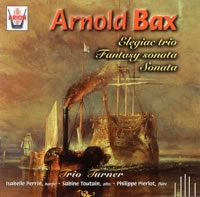
Arnold Bax: Elegiac Trio, Fantasy sonata, Sonata by Trio Turner
"Marvelously sensitive, uncommonly assured performances of some ravishing repertoire." Gramophone magazine Buy this album now CD: £14.00 + p&p |
| Artist Profile and index of recordings and sheet music |
| Track Listings | |||
| 1 | Elegiac trio | For flute, viola and harp | 9.22 |
| Fantasy Sonata | For viola and harp | ||
| 2 | I. Allegro molto | 6.55 |
|
| 3 | II. Allegro moderato | 4.03 |
|
| 4 | III. Lento espressivo | 7.30 |
|
| 5 | IV. Allegro | 6.09 |
|
| Sonata | For flute and harp | ||
| 6 | I. Allegro moderato | 6.40 |
|
| 7 | II. Lento | 6.56 |
|
| 8 | III. Moderato giocoso | 5.17 |
|
Sleeve Notes
An Irishman at Heart
Many artists of the late 19th century, whether impressionists or symbolists, had a constant predilection for dreams and faraway places, their perpetual quest for 'paradis artificiels’ (1) asserting itself as an antidote to everyday reality whose mundaneness and banality they rejected. Ancient mythology was regarded as a very fertile area for such exploration and, as we know, its resurgence provided one of the most common themes of inspiration for painters and writers of the time, while the works of Wagner, lying at the junction between Celtic, Scandinavian, Germanic and Christian traditions, acted as a particularly eloquent premonition where music was concerned. In France and the United Kingdom, Celtic myth was closely linked with literature and symbolist painting, as well as with the blossoming of impressionism in music—the seeds of a new language having been sown in the middle of the century by Tristan und Isolde. That affinity may be explained by the Celtic temperament. Renan (2), himself of Breton origin, underlined the idealism, the faculty of internalisation and the Celtic race’s propensity for contemplation: ‘The Celt has always persisted in confusing dream and reality’. This capacity for escaping into a dream world may be seen in the legends, generally shrouded in haze, of the Celtic tradition.
In Great Britain, the final years of the 19th century saw the development of The Celtic Twilight, a generic phrase for the whole Irish revival in literature, so named after a collection of stories by W.B. Yeats, published in 1893. The revival of Irish myths in Yeats’s poems and stories (e.g. The Wanderings of Oisin, 1889) and in the plays of J.M. Synge and Æ (pseudonym of George Russell) seems to have been closely related to the Irish struggle for independence. In music, Celtic inspiration left its mark a decade later on the works of Granville Bantock, John Ireland, Joseph Holbrooke and Rutland Boughton (3) None, however, were to take it to such heights as Arnold Bax. Indeed, this artist, born in Streatham, Surrey in 1883, was to identify so strongly with Ireland that his works as a musician were deeply marked for almost a quarter of a century not only by Irish tradition but also by the country’s political tribulations: the pieces presented in this programme provide some particularly remarkable examples.
At a time (the inter war years) when anti-Romanticism was in full swing, Bax — who was then at the height of his career and was quite rightly considered, along with Vaughan Williams, as the greatest living British composer—did not hesitate to qualify himself as a ‘brazen Romanticist’. At a time when Romantic values were harshly criticised as being the vestiges of an execrated past and the avant-garde was advocating more than anything else a hypothetical objectivity seasoned with concision and restraint (with Satie in France raised to the rank of prophet of the new religion), Bax composed some ambitious and forceful works, the rich texture of which was an open reference to pre-1914 Art Nouveau. This unashamed Romanticism undoubtedly provided very fertile ground for the dream-clouded nostalgia of the Celtic tradition.
The affluence of his youth, spent with culture-loving parents in a vast property in Hampstead, helped to draw forth his artistic predispositions which were certainly not confined to music: indeed, as he later showed in the poems, novels and plays he published under the Irish pseudonym Dermot O'Byrne, he also had a talent for literature which was on a par with his musical gifts (4). For five years (1900-1905) he studied at the Royal Academy of Music, where he followed the somewhat unorthodox teaching of Frederick Cord er, the freedom of which, far from checking to his extraordinary ability, opened up new horizons to him in the figures of Wagner and Liszt—symbols of modernity at a time when the RAM’s rival institution, the Royal College of Music, was still rigidly set, through Stanford, in the cult of Brahms.
It was his contact with Ireland, however, after his studies, at the age of twenty-two, that precipitated his musical style to maturity. In the company of his brother Clifford, a well-known dramatist, he set out to discover the Irish “Far West”, a land that was still wild and permeated by the Celtic tradition. Yeats’s poetry and Synge’s plays had given him the keys to the misty kingdom of old Irish legends; contact with the country itself transformed that poetic imagery into reality. The magical beauty of the islands, lakes and windswept hilltops were an unforgettable experience to which he constantly returned. His fundamentally nostalgic temperament found itself completely in its element in such surroundings. More than to any other, it was given to him to glimpse that mythical happiness of the Celts as it had never been on earth, translate it into radiant and rapturous sound, or plunge into the mystery of distant times forever lost. The sea and hills of Ireland, peopled with fearsome creatures, thus inspired his early tone poems such as In the Faery Hills (1909). That time also coincided with a period of intense literary activity, stimulated by his relations with the coteries in Dublin. The poems he wrote between 1905 and 1919 reflect his enthusiasm of that time for the early works of Yeats, for Æ and for Fiona Macleod (pseudonym of the Scotsman William Sharp). In his texts, pervaded by the Celtic tradition, this upper-middle-class Londoner practically established himself as an Irishman by adoption, who made friends with patriots such as Patrick Pearse.
The programme presented here is an eloquent
illustration of that Irish vein. In his earlier works Bax identified
with a Celtic ‘dreamland’ peopled with heroes and blazing
sunsets; these very personal pieces, however, express, rather, the
dissolution of his dreams in the streets of Dublin following the bloody
repression of the Easter Rising in 1916. The musician’s doppelganger,
Dermot O’Byrne, then produced nine poems of indignation bearing
the title “A Dublin Ballad” (also the title of the first
of the poems). Although it appeared in print, this pamphlet was banned
by the censors and was never published. The last verses of «A
Dublin Ballad» show how painful and intense was the musician’s
bitterness:
“Well, the last fire is trodden
down,
Our dead are rotting fast in lime,
We all can sneak back into town,
Stravague about as in old time,
And stare at gaps of grey and blue
Where Lower Mount Street used to be,
And where flies hum round muck we knew
For Abbey Street and Eden Quay.
And when the devil’s made us wise
Each in his own peculiar hell,
With desert hearts and drunken eyes
We’re free to sentimentalize
By corners where the martyrs fell.”
The execution of Bax’s friends—particularly
Patrick Pearse—inspired not only poetry (‘To what last music
did your mind awaken / In the barracks square, on this rainy morning’)
but also a series of compositions which are all the more poignant in
that they avoid all melodramatic effect. Apart from the three works presented
here, the admirable Harp Quintet (1919), the Oboe Quintet (1922) and
the Nonet (1928-30) complete the evidence of Bax’s vibrant pro-Irish
commitment.
Bax was a fine master of large-scale orchestral works, but in the more limited framework of chamber music, he reveals a sense of atmosphere and instrumental colour that is all the greater in that the harp (an obvious choice for music with a Celtic ambience) plays a central role. In his immense output of chamber works Bax often composed with a particular instrumentalist in mind, whose technique then sometimes influenced his style. Thus, in the late 1920s, when Maria Korchinska, a harpist who had been trained in the most authentic Russian tradition at the Moscow Conservatory, appeared on the London music scene, Bax’s instrumental style tended to reject the relative soberness of his earlier works which had been influenced by his former ideal, the English harpist Gwendolen Mason, who was a legatee of the French tradition. The latter’s style is therefore to be felt in the Trio, while the more flamboyant style of Korchinska prevails in the other two works.
Elegiac Trio
This is one of the three works Bax composed in 1916 as an immediate reaction
to the events of the Easter Rising. (The other two were Irish Elegy
for cor anglais, harp and string quartet and the tone poem In Memoriam
Pedraig Pearse.) There is no dedication to specify the author’s
intentions, and the piece has no definite programme. Banishing lamentation,
which would have been unnecessarily sensational, Bax expresses instead
the foundering of a dream: he poignantly evokes a distant past-the
Golden Age of the ancient Celtic Paradise—which has now vanished
for ever. Of course, the looming figure of a bard can be made out behind
the arpeggios of the harp, while the viola and flute soar in arabesques
and roulades. The Trio is subdivided into two parts which are played
without a break. In the first one, which is clearly more developed,
the melody played by the viola and flute comes to the fore and gradually
moves from a ‘doux et expressif’ to a more demonstrative
affirmation. The use of the harp’s harmonics and glissandi beneath
the trills of the viola and flute illustrates a very characteristic
exploration of timbre (page 12 of the score). In the second part, which
is much slower, the viola joins the harp (right hand) in a noble elegy
ornamented by the figuration and ethereal trills of the flute (page
16 of the score).
Dated April-May 1916, the Trio was first performed
on 26 March 1917 at the Aeolian Hall in London by Albert Fransella (flute),
the composer H. Waldo Warner (viola) and Myriam Timothy (harp). Seven
weeks earlier, the same musicians had given the British première
of Debussy’s Sonata for the same instruments. The similarity between
the two works did not escape the audience but, as the dates prove, Bax
could not have known Debussy’s score when he was working on his
Trio.
Fantasie Sonata
Bax was constantly influenced by Russian music. Some of his piano pieces
are like brilliant pastiches in the luxuriant style of Balakirev
and Rachmaninov, while his ballet The Truth about the Russian Dancers
shows his fascination for the Ballets Russes. In about 1926 he became
friends with an immigrant couple, Count and Countess Benckendorff,
and he and his muse, the pianist Harriet Cohen, became a regular
visitor to their residence in Ipswich. The countess was none other
than the famous harpist Maria Korchinska, and her husband, who was
a talented flautist, had adopted the pseudonym Constantin Kony. The
last two works in this programme owe their existence to the close
relationship that existed between Bax and the count and countess.
Korchinska’s dazzling technique is no doubt reflected in the
pieces Bax composed for her. Bax was little inclined to take into
account the difficulties his works might cause for interpreters,
an attitude that was further reinforced by the Russian harpist who
showed him that, in the hands of a great interpreter, the instrument’s
possibilities could be almost unlimited.
The manuscript of the Fantasy Sonata, dated April 1927, was dedicated to Korchinska and is marked ‘for viola and ham’. A few months later, when it was published, the instruments had been inverted: ‘for harp and viola’. Indeed, the harp is not limited in this piece to an accompanying role, the two protagonists in this duo—in the full sense of the term—are genuinely on an equal footing. Bax was at the height of his creative powers at that time and the density in the dialogue between the harp and the viola, fulfilling the promises of the title (two equal partners), the wealth of melodic and harmonic invention and the originality of the whole conception are in a similar vein to his great accomplishments of that time (his Symphonies nos. 3 and 4).
We notice several echoes of the Sonata for viola and piano (1922): a few phrases from the earlier work seem to have surreptitiously slipped from his pen. None of the themes specifically refer to Irish folklore, but their modal flavour and the dance rhythms we encounter in the piece create an undeniably Irish atmosphere, while the narrative character of the work as a whole, like the Elegiac Trio, nostalgically evokes distant bygone days which have sadly been refuted not only by the crisis of 1916 but also by the prosaic necessities of independence, which was dearly acquired five years later. The distinctive quality of this ‘musical tale’ rests on the important role played by the theme that is immediately struck up by the viola. The same long modal phrase (Dorian mode) is heard again during the transitions from one movement to the next, like a bard providing a prelude to the different episodes in a narrative. Most of the other motifs are overtly derived from it: for example, the robust waltz which acts as a scherzo (hesitating between a Phrygian G and a Lydian G) and the refrain in the finale. The very great beauty of the slow movement is highly representative of Bax’s harmonic refinement, the exposition of the first motif (in hypolydian C), played by the harp, setting this capricious melodic improvisation in a casket of sparkling and subtly impressionistic chords, while the second theme, ‘più mosso’, soars with the viola above the flowing arpeggios à la Fauré of the harp. And the repeat of the first motif (viola and harp, left hand) over a hypnotic rocking from the right hand is indeed bathed in the eerie light of blissful, mythical realms. The same ecstasy, but this time a source of great joy, transforms the final return of the leitmotiv at the end of the finale into a unique moment of pure Celtic magic, apparently paraphrasing Fiona Macleod’s profession of faith: the land the Celts most ardently desire, the latter said, is not Ireland, Scotland or Brittany but ‘a rainbow land, the vague land of youth, the shadowy Land of Heart’s Desire... and deep in the songs we love above all others is a lamentation for what is gone away from the world, rather than merely from us as a people’.
The Fantasy Sonata was first performed by Maria Korchinska in October 1927 at the Wigmore Hall in London during a memorable concert devoted entirely to works by Bax, in which the oboist Leon Goossens and the pianist Harriet Cohen also took part.
Sonata for
flute and harp
Composed the following year (1928), the Sonata for flute and harp may
appear to be a ‘younger sister’ of the Sonata for harp and
viola. It is clearly a less ambitious work but it still reflects the
atmosphere of Ireland, to which Bax regularly returned in summer as a
member of a jury for examinations in Cork. In the opening Allegro moderato
the highly rhythmical spirit of the first theme and the frankness of
its harmonisation in Phrygian C contrast with the expressive lyricism
and chromatic harmonies of a second theme in hypolydian F. These themes
are then repeated in a very condensed form over chords from the harp
performed simultaneously and held (‘plaqués’). The
slow movement takes the form of a song—like piece-a ‘Cavatina’—with
two clearly distinctive sections: an improvisation for the flute in the
form of recitative punctuated by arpeggiated chords from the harp, then
a middle section with a contrast between the rising octaves of the harp
and the passionate lyricism of the flute. In the final movement, a lively
dance theme is interrupted twice to make way for a lyrical motif with
a strong Irish modal flavour.
Dedicated to Count Beckendorff, the Sonata was first performed by him (under his pseudonym Constantin Kony) and by Maria Korchinska at the Central Library, lpswich on 19 January 1929. In 1936 Bax rewrote it as a Septet for flute, oboe, harp and string quartet. The Cavatina (second movement) was performed on its own at a concert given at the National Gallery in London in 1943, with a violin instead of the flute.
Michel FLEURY
(1) title of a work
by Baudelaire (1860)
(2) Ernest Renan (1823-1892), French writer, philosopher, historian and
scholar of religion, a leader of the school of critical philosophy in
France.
(3) Although Bantock, Ireland and Holbrooke were of Scottish descent,
these musicians of English birth were not boned to The celtic Twilight
by an ethnic or political identity like the writers.
(4) His younger brother, Clifford, pursued a literary career and became
famous fur his plays and short stories.
Credits
Recorded by Salle Adyar, December
1997.
Produced by Franck Jaffrès (studio Cédéris)
Cover Image: The Fighting Temeraire by William turner (1775-1851) London
National Gallery. Photographed by AKG / Erich Lessing
Booklet photographs: Alain Mercier
Graphic Design: Céline Poilleux
Made in France
| Instruments: | Trio: Flute, viola and harp |
| Genre: | Classical |
| Format: | Audio CD [DDD] |
| Our Ref: | A0165 |
| MCPS: | ARN68423 |
| Label: | Arion |
| Year: | 1998 |
| Origin: | France |