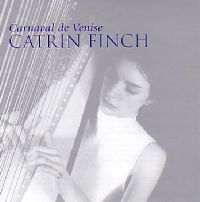
CD A0127: Carnaval de Venise

Carnaval de Venise by Catrin Finch

CD cover: Carnaval de Venise by Catrin Finch

Carnaval de Venise is one of Catrin Finch's earliest CDs on which she performs a stunning international programme of music for the harp. Remarkable performances from one of the brightest stars in the harp world today.

Buy this album now    CD: £12.98 + p&p   

Audio Samples

Track Listings

  J S Bach (1685-1750)  
  Italian Concerto  
1 i
4.10
2 ii
5.01
3 iii
4.10
  Paul Hindemith (1895-1963)  
  Sonata  
4 i
5.25
5 ii
2.16
6 iii
3.45
7 Gabriel Faure (1845-1924)
Impromptu - Opus 86
9.14
8 E. Parish-Alvars (1808-1849),
Introductions and Variations, on themes from Bellini's 'Norma'
11.06
9 Carlos Salzedo (1885-1961)
Ballade - Opus 28
9.39
10 John Thomas (1826-1913),
Bugeilio'r Gwenith Gwyn - Watching the Wheat
3.48
11 Felix Godefroid (1818-1897)
Carnaval de Venise
10.26
     

CD Notes & Credits

Sleeve Notes

Italian Concerto - I.S. Bach 1685-1750
The Goldberg Variations and the Italian Concerto are two works which stand out in Bach's keyboard compositions. The Variations, written in 1742 are the apotheosis of his intellect and the Concerto written in 1735, a distillation of original ideas but influenced by all the arrangements he made of the Concerti of Vivaldi (and other Italian composers) for solo harpsichord.

It is interesting to note that Handel was writing original music for the harp at the same time, and of course, musicians were always borrowing from each other's repertoire. The Italian Concerto sounds particularly well on the harp.

The first movement has a fanfare-like opening and this "tutti" is artfully contrasted with 'solo' passages. The slow movement is remarkable for the lovely long melodic line which is spun over a simple bass and thirds which act as a harmonic counterpoint. The last movement is full of exciting scales, fascinating counterpoint and rushes headlong to a magnificent close.

Sonata - Paul Hindemith 1895-1963 Mässig-Schnell - Lebhaft - Sehr Langsam
In Germany, Hindemith is considered the successor to Richard Strauss. However his style is quite different, embracing neo-classicism, atonality and the baroque structures of J.S. Bach. Harpists are indeed lucky to have such a composition in their repertoire.

Written for Clelia Gatti Aldrovandi in 1939, the Harp Sonata is romantic in nature though classical in structure. The third movement, "Lied" is prefaced by one of Hòlty's poems, and this becomes the 'argument' of the whole Sonata.

The first movement suggests the massive architecture of the Church, the second - a scherzo, children playing games, and the third follows the words of the poem. In fact, the words can be scanned with the melodic line.

Lied
 
Dear friends, when I have departed,
Place the little harp behind the altar,
Where on the wall, the wreaths of
Many young maidens gleam.
 
Then, the sexton shows the little harp
To the friendly traveller, and the

Red ribbon, twined around the harp,

Rustles and flutters below the golden strings
 
Often at sunset - he says with awe,
The strings hum quietly like bees,
And the children, hearing the sounds
Run in from the churchyard and

See the wreaths quivering.
 
L. H. Chr: Hòlty


Impromptu - Opus 86 - Gabriel Fauré
Fauré will always be remembered for his wonderful song-writing; beautiful melodies ­memorable yet refined - and an unusual sensitivity for the poetry he set to music.

The Impromptu, which was commissioned in 1904, is unusual as it lacks the rhapsodic flow found in many of his compositions. Instead he juxtaposes a theme in noble chords with melodic fragments of nocturnal beauty. The second part again announces the initial theme (this time in Arpeggi) and moves toward two variations of suspended magic and a brilliant coda.

It is now known that the dedicatee, Alphonse Hasselmans, had a hand in the composition. Some of the figurations in the second half come from him. As the manuscript is lost, we shall never know to what extent he wrote, or re-wrote certain passages. However the piece remains in every harpist's repertoire, an important addition to recital programmes.

Introduction and Variations - Op. 36 - Elias Parish Alvars 1808-1849
On themes from "Nonna" by Bellini
Parish Alvars was the most famous harpist of the nineteenth century and his spectacular playing prompted Berlioz to call him the "Liszt of the Harp".

He was born in Teignmouth, Devon, and subsequently studied with Dizi Labarre and Bochsa. At the age of sixteen he was already well known as a performer. His successful concert tours took him all over Europe and also to the Middle East. In 1846 he stayed in Leipzig where his friendship with Mendelssohn had a powerful effect on his last compositions. In 1847 he settled in Vienna and was appointed Chamber Musician to the Emperor. He died there in 1849.

He made many arrangements of operatic themes, wrote several concerti, and his legacy of "Bel Canto" pieces is the most prolific and important in the harpist's repertoire.

Ballade - Opus 28 - CarIos Salzedo 1885-1961
Born in France, Salzedo distinguished himself early, playing both piano and harp. In fact, at the age of sixteen, he won his "Premier Prix" on both instruments on the same day at the Paris Conservatoire.

In 1909 he was appointed harpist to the Metropolitan Opera House, beginning a career in the United States which was to have an important influence on harpists and composers alike.

Tiring of the Harp's romantic image, he wrote compositions which incorporated new sounds and effects. Edgar Varese was one of the first composers to use these effects, assuring the harp a secure and important place in contemporary music.

The Ballade appeared in 1914, one of Salzedo's earliest compositions. Of supreme technical difficulty, it is still cast in a romantic idiom, reminding one of Liszt's musical legacy. However there are moments of impressionism and fascinating harmonic progressions. Ingenious chromaticism and repeated notes introduce more modern elements.

Watching the wheat - John Thomas 1826-1913 Bugeilio'r Gwenith Gwyn
John Thomas was born in Bridgend, South Wales. He showed such promise at an early age that Lady Lovelace (the daughter of Byron) enabled him to study at the Royal Academy of Music in London.

He was prolific as a composer and arranger and is probably still best known for his folk song arrangements, which are often played by harpists today. "Watching the wheat" is certainly the most popular one and in the final variation, the melody is embroidered with delicate arpeggi in the most delightful way.

Carnaval de Venise - Felix Godefròid 1818-1897
Felix Godefroid was born in Namur, Belgium, and studied with Nadermann and Parish Alvars. Berlioz wrote:- "He is the master of his instrument and of such formidable force that there can be no comparison". His compositions are in a grand romantic style freeing themselves from the more classic style of Parish Alvars. He was well known for his four finger trills and they found their way into many of his compositions including the Carnival of Venice. This famous theme was used by many composers, most notably Paganini, and Godefroid has written variations which are fascinating for the contrasts in subtle and devilish techniques.

Programme notes by Professor David Watkins, FGSM, Hon ARAM

© 2001 David Watkins

Credits

A digital recording made at Sain Studios, Llandurrog, in November, 2000.
Producer Elinor Bennett.
Studio and editing engineer Siwan Lisa Evans.
Studio manager Eryl Bryn Davies.
Director Dafydd lwan.
Photography Gwynant Parri

Made in Wales

Album Information

Instruments: Harp
Genre: Classical
Format: CD
Our Ref: A0127
MCPS: SCD2280
Label: Sain
Year: 2001
Origin: Wales (UK)

Artist Information & Contact Details

Photograph of Catrin Finch

Catrin Finch (Harp)

Catrin was born in Wales in 1980, and began the harp at the age of 8 with Elinor Bennett. At 16 she moved to London to attend the Purcell School of Music, and to study with Skaila Kanga, with whom she is continuing her studies at the Royal Academy of Music. Her list of achievements is remarkable for one so young. She won first prize in the junior section of the 1991 World Harp FestivaL and in 1994, while still only 14, she won second prize in the senior competition. Other prizes include the Nansi Richards prize in 1997, the Instrumental Blue Riband at the 1998 National Eisteddfod of Wales, and the Marisa Robles Harp prize in the Royal Overseas League Competition. In September 1999, Catrin won the Lily Laskine International Harp Competition in Paris, where the prize included a new harp and numerous solo engagements throughout Europe. In March 2000, she gave her London debut at the Wigmore Hall and in the same year she was awarded the Young Concert Artists (New York) prize, which has given her three years representation in the USA and worldwide, including debuts in New York, Washington and Boston. She was the principal harp of the National Youth Orchestra of Great Britain from 1990 to 1996, and was the youngest member to perform at a BBC Promenade concert at the Royal Albert Hall. On leaving, she was awarded the Arthur Bulgin medal for her outstanding contribution. Recent recitals include the AI Bustan Festival in Lebanon, the Val d'Aulnay and Gargillesse Festivals in France and a recital for Salvi Harps in Turin. Future concerto appearances are scheduled with the BBC National Orchestra of Wales and the Royal Academy of Music Symphony Orchestra, and future concerts in the USA. Sri Lanka and Bangkok. In May 2000, she accepted a Royal Appointment as Harpist to HRH The Prince of Wales, thus following in the tradition of the famous Welsh harpist John Thomas, Pencerdd Gwalia, the previous holder of this position.

Please note that this biography is from the CD book written in 2001 -  for up to date info on Catrin ........

Click here to go to Catrin Finch's web site

Manager: Gwawr Owen
Email: kissanmanagement@yahoo.com
Tel: +44 (0)78 0519 0522
   
Record Label: universal / Deutsche Gramophon Hamburg, Germany
 
Artist Web Site   www.catrinfinch.com

Other Recordings by Catrin Finch

Available from Creighton's Collection
Click for more details Click for more details Click for more details Click for more details Click for more details
Carnaval de Venise
Kissan
Clasurol
String Theory Live Little
Angels